
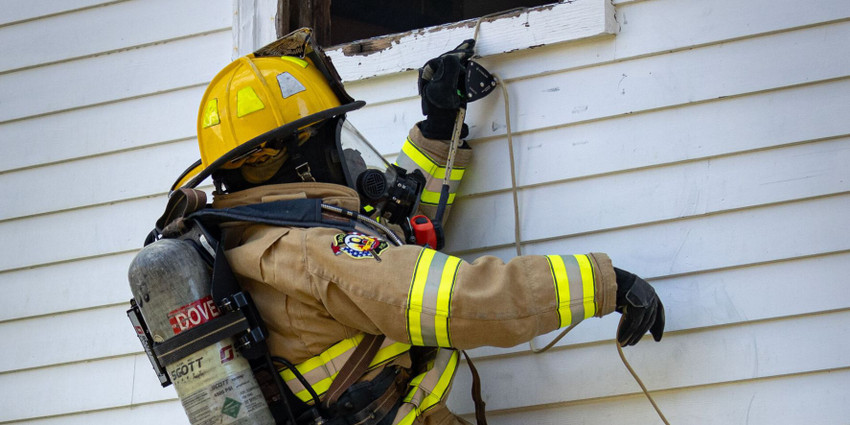
Personal Escape Systems for Fire and Rescue
Personal Escape Systems Explained: Gear, Standards, and What to Look For
Personal Escape Systems are purpose built life safety systems designed for one critical function. Emergency self-rescue from height when no other exit is available. In fire, they represent a last-resort option when interior conditions rapidly deteriorate.
For departments evaluating options within the Rescue Direct Personal Escape collection, it is essential to understand how each component functions as part of a complete system and how that system integrates with the harness or escape belt worn by the user.
Core Components of a Personal Escape System
A Personal Escape System is only as effective as the integration of its components. Each element must perform reliably under extreme conditions.
- Descent Device: The descent device controls the rate of descent and must be compatible with the rope used. Depending on the system, devices may be automatically locking or manually braking. An example of a manual braking device would be a miniature figure 8, like the Rock Exotica MiniEight. While these devices are lightweight, and affordable, they require very high degree of training and manual dexterity to operate correctly. A mistake may result in an uncontrolled fall. An autolocking device like the Sterling FCX locks onto the rope automatically, and requires input to descend, a safer option in a high stress environement. In both cases, training and control of the rope are critical.
- Escape Line: These can be in either a rope or some devices like the CMC Lever, which utilize a webbing construction. They are all made of heat-resistant fibres such as Technora or Kevlar, making them better suited to fireground conditions than traditional nylon or polyester.
- Anchor System: These come in several shapes and configurations, with the most common being a fishook shape. These types of anchors create the potential to create an anchor where no other option may exists, particularly in windowsills, the most common egress point. Made of steel or aluminum, they must be readily accessible and rated for the purpose of personal escape.
-
Harness or Escape Belt System Foundation: The harness is the critical interface between the user and the system. It directly affects load distribution, control, and overall system performance. Two primary configurations are used in the field: Escape belts (Class 1) waist-only systems that are lightweight and designed for self-rescue, and Class II harnesses seat harness systems that provide improved stability and load distribution.
Standards and Certifications
The primary standard governing personal escape systems is NFPA 2500: Standard on Operations and Training for Technical Search and Rescue Incidents and Life Safety Rope and Equipment for Emergency Services.
NFPA 2500 consolidates and replaces several previous standards, including NFPA 1983, which is no longer the current designation.
The standard establishes performance and testing requirements for:
- Life safety rope
- Escape and bailout systems
- Harnesses
- Carabiners and connectors
- Anchors and related hardware
Compliance helps ensure that equipment meets established requirements for strength, durability, heat resistance, and performance under load. For fire service, rescue, and technical operations, using equipment certified to the current NFPA standard is essential for safety and operational readiness.
Note: NFPA 2500 replaced NFPA 1983 and other related standards as part of NFPA's standards consolidation initiative.
What to Look for When Choosing a System
Selecting a Personal Escape System should be based on real-world usability. Under stress, simplicity and reliability are critical.
Key evaluation factors include:
• Deployment efficiency with one hand in low visibility conditions
• Seamless integration with the harness or escape belt
• Durability against heat, abrasion, and sharp edges
• Low profile carry that remains accessible
• Realistic training requirements for your team
A Personal Escape System is a fully integrated life safety solution built around four essential elements:
• Controlled descent device
• Heat-resistant escape line
• Reliable anchor system
• Properly fitted harness or escape belt
The harness is often underestimated, yet it is the component that directly connects the user to the system and manages load during descent.
For fire departments and rescue teams, the priority is clear:
• Select NFPA compliant equipment
• Ensure compatibility across all components
• Train regularly under realistic conditions
When a bailout becomes necessary, there is no margin for hesitation. The system must deploy immediately, perform consistently, and function as expected every time.
Training Is Just as Important as the Equipment
Selecting a personal escape system is only part of the equation. Proper training is essential to ensure that personnel can deploy and use the equipment safely and effectively under stress.
Emergency escape situations are often high-pressure, low-visibility events where there is little time to think through procedures. Regular training helps build familiarity with the equipment, reinforces proper techniques, and improves confidence when every second matters.
Organizations should ensure that personnel receive initial instruction as well as ongoing refresher training that covers equipment inspection, anchoring methods, deployment procedures, and emergency descent techniques. Even the best equipment can fail to provide the intended level of protection if users are not adequately trained in its operation.
When evaluating personal escape systems, consider training requirements and available training resources as carefully as you evaluate the equipment itself. A well-trained user is one of the most important components of any life safety system.