
Confined Space Rigging: Adapting Rescue Systems for Restricted Environments
Confined space rescue rarely allows for ideal rigging conditions. Unlike open terrain operations, rescuers must work within tight access points, limited movement areas, restricted anchor options, and reduced personnel access around the entry. A setup that works efficiently on a training tower or open edge often has to be completely rethought when operating inside a manhole, tank, silo, or underground utility vault.
Successful confined space rigging depends on preparation, simplicity, and control. Systems must be efficient enough to operate in restricted environments while still maintaining redundancy, safe patient movement, and clear communication between team members. In many cases, the most effective solution is not the most complex system, but the one that can be deployed quickly, operated smoothly, and managed safely under limited space conditions.
Confined space operations also extend far beyond the rigging itself. Rescue teams must coordinate with broader safety procedures including atmospheric monitoring, ventilation, lockout and isolation protocols, permit systems, and continuous communication practices. According to standards established by the Occupational Safety and Health Administration (OSHA), permit-required confined spaces must incorporate retrieval systems designed to support non-entry rescue whenever possible. This includes the use of full-body harnesses, retrieval lines, and mechanical devices capable of safely removing an entrant without requiring additional rescuers to enter the space. These requirements reinforce the importance of designing rigging systems that support efficient vertical movement while minimizing exposure to additional personnel.
Training is equally critical. Standards such as National Fire Protection Association NFPA 1006 outline the competencies required for technical rescue disciplines including confined space and rope rescue operations. Teams operating in these environments must be proficient not only in rope systems and mechanical advantage setups, but also in hazard recognition, patient packaging, atmospheric awareness, and coordinated rescue execution under restricted conditions.
What Makes A Confined Space Different
Confined spaces aren't built for human occupancy. Manholes, silos, tanks, and underground utility vaults all share the same characteristics: limited openings, narrow entry points, obstructed movement paths, limited escape options, poor ventilation, and a tendency to trap gases that can incapacitate a worker before anything seems wrong. Many of the most dangerous hazards are invisible. Toxic gases, oxygen-deficient atmospheres, or flammable vapours may be present without any visual warning signs. No colour, no smell, no time.
Entry conditions have to be confirmed before anyone approaches the opening. Oxygen needs to sit between 19.5% and 23.5%. The space has to be clear of flammable vapours and toxic gases, with hydrogen sulphide and carbon monoxide being the most common culprits. All energy sources get isolated and locked out. Ventilation runs before entry. Retrieval systems need to be physically rigged and verified functional before the first person goes in, not staged nearby in a bag.
- Oxygen levels confirmed between 19.5% and 23.5%
- Flammable vapours and toxic gases tested and cleared
- All energy sources isolated and locked out
- Ventilation running before entry begins
- Retrieval system rigged, tested, and ready at the opening
- Entry permit signed and supervisor confirmed
Permit-required confined space operations must include appropriate harnesses, retrieval lines, and mechanical devices capable of non-entry rescue. If someone goes down, the system gets them out without sending another person in after them. That requirement shapes everything above the entry point: the anchor, the retrieval device, and the rope path.
NFPA 1006 sets the competency baseline on the technical side. Teams working these environments need proficiency across the full operation including hazard assessment, atmospheric monitoring, rigging, patient packaging, and coordinated rescue execution. Not just the rope work. These aren't bureaucratic checkboxes. They're the conditions that define whether the job is safe to start.
Patient Packaging
The Attendant Role: One Person, One Responsibility
Every confined space entry requires a dedicated attendant positioned outside the opening for the duration of the operation. This role carries a singular responsibility: monitoring the entrant and maintaining continuous awareness of conditions inside and outside the space. The attendant cannot divide attention between multiple tasks, assist with unrelated equipment, or leave the entry point unattended.
Communication between the entrant and attendant must remain constant throughout the operation. Depending on the environment, this may involve radios, hardline communication systems, hand signals, or rope-tug communication methods. If communication is lost, teams must follow predetermined emergency procedures and safe exit protocols immediately.
Entrants are typically equipped with a full-body harness featuring shoulder-mounted or dorsal retrieval attachment points connected to a mechanical retrieval line. Whenever the space configuration allows, the objective is to perform a non-entry rescue. If an entrant becomes incapacitated, rescuers should be able to remove them without sending additional personnel into the hazard zone. The retrieval line, mechanical device, and overhead rigging system must all be capable of supporting that operation quickly, efficiently, and under load.
Low Headroom: Managing Vertical Limitations
The first thing that bites you is headroom. Every piece of hardware in your system, pulleys, carabiners, knots, progress capture devices, takes up vertical space. Stack them all together, and you can lose a significant chunk of usable lift height before the load even moves. In a tight space, that's not a minor inconvenience; it can render an otherwise solid system nearly useless.
The fix is discipline in gear selection. Low-profile pulleys, compact mechanical advantage configurations, and eliminating any hardware that isn't earning its place on the system. Pre-rigging before the operation starts means you're not improvising in the hole, and clean rope management keeps tangles from eating into the clearance you worked hard to preserve.
No Traditional Anchors: Building Artificial High Points
Most confined space entries aren't built with rescue in mind. The surrounding walls, railings, or overhead structure may not be rated for rescue loads, or they may be positioned in a way that creates a terrible load angle. Relying on them is a gamble you don't want to take.
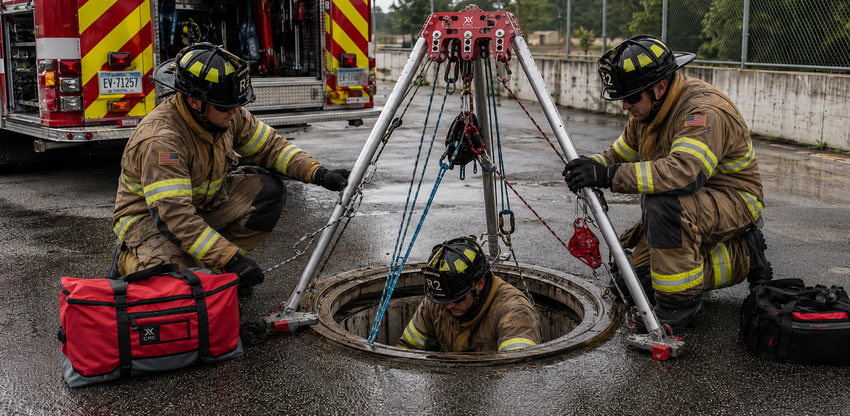
Portable solutions such as tripods and davit arms allow rescuers to establish a controlled, overhead anchor point directly above the entry. These systems improve load direction, reduce edge friction, and increase overall system efficiency. Proper setup, load rating, and stability are essential to ensure safety under dynamic rescue conditions.
Tripods are the standard choice for vertical entries like manholes: quick to set up, centred overhead, and stable under load. Davit systems handle offset entries and situations where headroom above the opening is limited. They can be mounted to portable, fixed, or vehicle bases and swung out over tanks or railings where a tripod won't fit.
It is important to note that tripods can tip over if the direction of pull falls outside the expected load path. The legs of a tripod are positioned to handle a centred, vertical load. If the patient or retrieval line shifts laterally, or if a haul system applies force at an angle outside the tripod's base, the structure can become unstable. Teams should always ensure the load remains centred, and use tag lines or secondary stabilisation when patient movement may create off-axis forces.
Both must be rated for the intended load and verified stable before anyone goes on the line. Setup takes time, which is exactly why it happens before the rescue, not during it.
Confined space rigging system: tripod over manhole, high point directional pulley, lowering and hauling system, safety line, and rescue subject below grade.
Tight entries mean fewer hands on the system. Plenty of confined space operations run with one or two technicians actively managing the rigging while the rest of the team works further back. That changes the demands on the system. It has to be simpler, better organized, and completely ready before the operation starts.
Pre-assigned roles, staged gear, and a pre-rigged system take most of the real-time decision-making off the table. Adjustments mid-rescue are slow, difficult, and add risk. The plan that works is the one that doesn't need to be rebuilt on the fly.
Supervisors carry a specific responsibility here. It's their job to review the entry plan, confirm the retrieval system is ready, and be willing to hold the operation if something changes. Taking a visible, active role in the pre-entry process builds a site culture where workers raise concerns before they become incidents.
None of this gear works reliably if it isn't maintained. Before each use, every component in the system gets checked. Tripod and davit structure for cracks, bends, corrosion, or missing pins. Winch and SRL-R cables for fraying, kinks, or retraction problems. Harnesses for webbing cuts, stitching integrity, and D-ring deformation. Retrieval and braking mechanisms tested for smooth, reliable operation.
Inspection logs are the record that equipment is fit for use and that someone confirmed it. Gaps in that record become problems if something goes wrong.
General industry standard. Requires a written confined space programme covering hazard assessment, entry permits, atmospheric monitoring, and rescue planning, with trained entrants, attendants, and supervisors in clearly assigned roles.
Applies the same framework to short-term construction entries. Requires isolation lockout, atmospheric testing, ventilation, and retrieval systems ready before work begins.
Sets technical competency requirements for confined space and rope rescue. Proficiency in rigging and confined space operations are not separate skills. They have to work together under restricted conditions and pressure.
Expands on OSHA requirements with best practices for training, hazard assessments, and entry planning. Widely used as an internal guide by organisations running confined space programmes.
Rigging in confined spaces is about adaptation. Limited headroom, lack of traditional anchors, and restricted team access all demand a more deliberate approach to system design. By focusing on compact systems, engineered anchor solutions, and disciplined pre-planning, rescue teams can operate safely and effectively in some of the most challenging environments they face.