
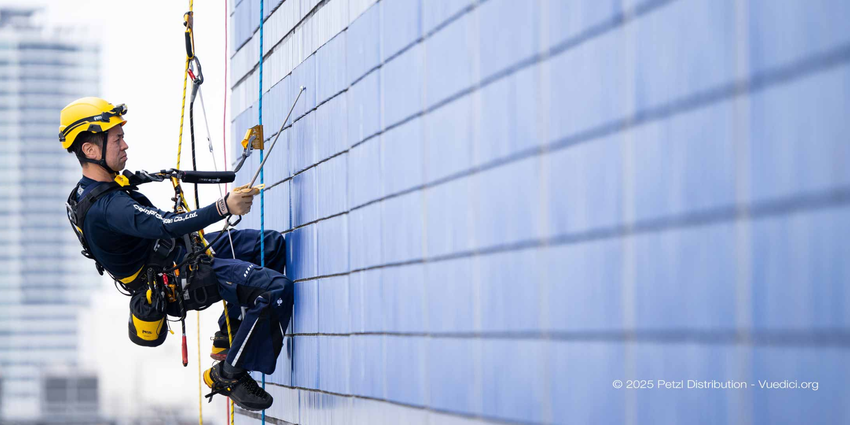
Rope Access Gear for IRATA and SPRAT Certification
From L1 fundamentals to L3 rescue leadership, build your kit with gear that supports safe, efficient rope access work.
Working toward IRATA or SPRAT certification requires your equipment to evolve alongside your skill set. In professional rope access, success is not defined by the amount of gear on your harness, but by how effectively each component functions within a safe and efficient system. At Level 1, the priority is to develop strong fundamentals and move with control and consistency on the rope. At Level 2, technicians expand into system building, rigging, and supporting rescue operations. At Level 3, equipment selection supports a higher level of responsibility, including planning, supervision, and leading safe, effective operations in complex environments.
IRATA vs. SPRAT: Does the Gear Change?
In most cases, no. From an equipment standpoint, the overlap between both systems is substantial. Each relies on the same core components, including harnesses, descenders, backup devices, ascenders, connectors, rope protection, and rescue capable hardware. The distinction is not the equipment itself, but the technician’s ability to apply it correctly, efficiently, and consistently in the field. The bigger difference is often regional preference and work environment. SPRAT is commonly favored in North America, while IRATA carries strong international recognition, , though that is changing rapidly as both certifications gain global recognition.
Regardless of the certification body, all equipment must meet the requirements of the jurisdiction in which it is being used.
L1: Master the Fundamentals.
At Level 1, your gear should be simple, reliable, and easy to manage. The goal is to become comfortable moving on rope, changing direction, using backup systems, and maintaining redundancy at all times. Focus on clean systems and full understanding of every piece of equipment you carry.
Technicians are introduced to standardized rope access systems under supervision. Equipment selection should align with the training provider's requirements and the company's procedures.
The following components represent gear commonly used in Level 1 rope access systems:
- Rope access harness suitable for work positioning and suspension
- Industrial safety helmet with chin strap
- Self-braking descender designed for rope access applications
- Chest ascender and handled ascender for rope progression
- Mobile fall arrester or backup device compatible with the working line
- Lanyards for attachment and positioning
- Locking connectors, typically triple-action carabiners
- Foot loop or foot ascender to improve climbing efficiency
- Low stretch kernmantle rope that meets applicable standards
Note: Specific equipment requirements may vary depending on the training organization, employer, and applicable standards. Always follow your training provider’s guidance and your company’s rope access procedures when selecting and using equipment.
L2: Build Systems, Not Just Movement.
At Level 2, rope access technicians begin moving beyond personal progression. This is where rigging, deviations, rebelay systems, hauling systems, and rescue scenarios become more important. Your kit should become more modular, with extra connectors, pulleys, progress capture devices, and rope protection ready for field use.
Equipment at this stage supports rigging, rope management, and basic rescue operations. Selection should always align with training provider guidance, company procedures, and the specific demands of the work environment.
The following components represent equipment commonly used at Level 2:
- Additional locking connectors to support rigging and system configuration
- Pulleys, including single and double sheave options, for mechanical advantage systems
- Progress capture devices or rope grabs
- Edge protection equipment
- Anchor slings or webbing for building temporary anchor systems
- Compact rigging plates or connectors to improve system organization
- Auxiliary cords or prusik loops for backup and progress capture applications
- Additional rope or system components to support deviations, rebelays, and rescues
L3: Lead Systems and Rescue Operations.
Level 3 technicians are responsible for system oversight, rescue planning, and operational decision-making. At this stage, gear selection is no longer just about personal use. It supports the team, the rescue plan, the environment, and the safest possible outcome.
Equipment selection supports a broader operational scope, including system design, supervision, and rescue readiness. Technicians at this level are responsible for ensuring that systems are efficient, redundant, and appropriate for the environment and team.
Rather than focusing on individual components alone, Level 3 gear often includes complete systems and team-based solutions.
Common equipment considerations include:
- Dedicated rescue kits designed for rapid deployment and team use
- High-efficiency pulleys and advanced mechanical devices for lowering and raising systems
- Multi-functional descent and haul control devices suitable for technical rescue applications
- Advanced rigging plates and connectors for complex system organization
- Rope protection systems designed for high-load or extended use scenarios
- Edge transition equipment or artificial high directional systems where required
- Pre-configured hauling or lowering systems to improve efficiency during operations
- Equipment selected to support team coordination, communication, and redundancy
Note: Level 3 responsibilities extend beyond individual equipment use. Gear selection should support team operations, rescue planning, and compliance with applicable standards. Final configurations should always be determined by qualified personnel based on the specific operational context.
Need Help Building a Rope Access Kit?
Our team can help you select gear for training, certification, rescue readiness, or department-level rope access operations.