
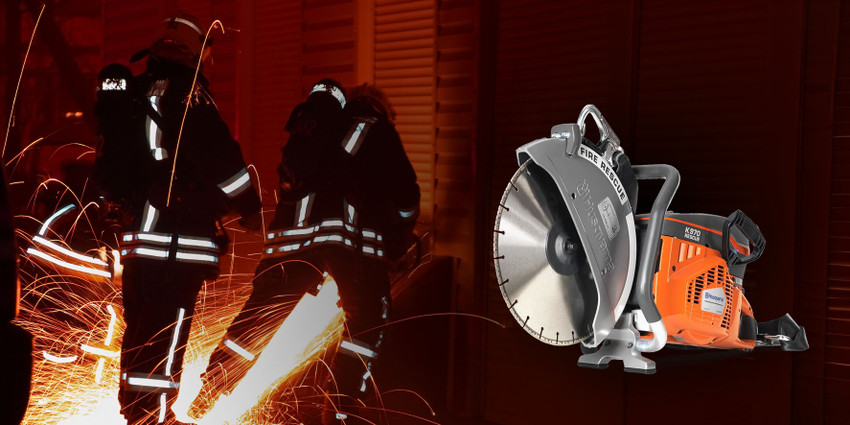
Husqvarna K970 Rescue Guide
Walk into fire stations across North America, and you'll find the same saw mounted on the rear step or staged in the tool compartment: the Husqvarna K970. It didn't earn that position through marketing. It earned it through a decade of consistent performance on residential roofs, commercial structures, and every bad-weather, low-visibility, high-pressure scenario the fire service throws at equipment.
The K970 platform has evolved into the K12FD94 engine, a refined version of the same design philosophy, but departments still call it the K970, and the reasons to spec it haven't changed.
When firefighters and rescue teams talk about dependable gas-powered rescue saws, the Husqvarna K970 Rescue Saw consistently comes up. The K970 has built a reputation across fire departments, USAR teams, industrial rescue units, and forcible entry instructors because it was designed specifically for emergency response environments where reliability matters more than convenience.
| |
Unlike standard construction cutoff saws adapted for rescue work, the K970 Rescue model was developed with firefighter operations in mind. Every detail from the oversized starter handle to the chromed blade guard and glove friendly controls supports operation under stress, low visibility, wet conditions, and structural firefighting PPE.
For departments evaluating rescue saw options, the K970 sits in an important category. It bridges the gap between lightweight ventilation saws and larger heavy demolition systems. It has enough cutting capacity for forcible entry, roof operations, security bars, concrete, vehicle extrication support, and metal breaching while remaining portable enough for rapid deployment.
This guide breaks down the K970 Rescue platform from a fireground perspective, not just a specification sheet. It explains what the features actually mean during operations, where the saw performs best, where it does not belong, and how departments can maximize service life through proper maintenance and inspection routines.
Teams comparing rescue saw options should also review our related guide on gas versus battery rescue saws for broader operational considerations between fuel powered and cordless systems.
What Makes The Husqvarna K970 Different From Standard Cutoff Saws
The K970 Rescue is based on Husqvarna’s professional-grade power cutter platform but includes several modifications specific to emergency services applications.
Key rescue-focused upgrades include:
- Chromed blade guard visible in smoke and low light
- Adjustable carry strap for rapid deployment
- Large D handle for operation with structural gloves
- Reversible cutting arm for confined cutting positions
- Enhanced starter handle designed for gloved hands
- Rescue specific color scheme for apparatus identification
- High power to weight ratio for extended cutting operations
The saw is designed around a 14-inch blade platform with a maximum cutting depth of approximately 5 inches, depending on blade selection.That depth allows crews to handle a wide range of fireground tasks, including:
- Commercial door breaching
- Roll-up door cutting
- Security bar removal
- Roof ventilation support
- Concrete and masonry access
- Vehicle post and hinge cutting support
- Industrial rescue access points
- Utility and infrastructure cutting operations
Understanding X-Torq Technology On The Fireground
One of the most important features in the K970 is Husqvarna’s X Torq engine system.
On paper, X Torq is marketed as a fuel-efficient, low-emission engine design. For rescue teams, however, the real value is operational performance under heavy load.
When crews cut thick steel, reinforced concrete, layered roofing materials, or security barriers, the engine experiences constant RPM fluctuation and resistance. Lower-quality saws can bog down during aggressive cuts, especially when operators apply inconsistent pressure or encounter mixed materials.
The X Torq system helps maintain stronger torque throughout the cutting cycle. That translates into:
• More consistent blade speed under load
• Reduced stalling during heavy cuts
• Improved performance in dense materials
• Lower fuel consumption during extended operations
• Reduced operator fatigue from fighting the saw
For firefighters, this matters most during prolonged forcible entry or multiple consecutive cuts where maintaining momentum directly impacts operational speed.
Departments running rescue saws during technical rescue training often notice the difference when cutting concrete slabs, structural steel, or layered commercial roofing assemblies.
The engine also produces lower emissions compared to older generation two-stroke rescue saws, which becomes important during training evolutions or operations in partially enclosed environments.
Why Autotune Matters For Rescue Teams
Traditional carbureted gas saws require periodic manual adjustment based on: Temperature changes, altitude, fuel quality, humidity, and air filter condition
For construction crews using saws daily, constant tuning adjustments may not be a major issue. Fire department rescue saws operate differently. Many department saws sit on apparatus for days or weeks between calls. Then suddenly, they are expected to start immediately and run at full power during high-stress incidents.
Autotune automatically manages air and fuel mixture adjustments electronically. From a fireground perspective, this provides several advantages:
Autotune Advantages
More Reliable Starts | The saw adapts to environmental conditions without requiring manual carburetor tuning. |
Better Idle Stability | The saw is less likely to stall while crews reposition or prepare cuts. |
Consistent Performance After Storage | Departments experience fewer operational inconsistencies after long periods without use. |
Reduced Maintenance Complexity | Technicians spend less time adjusting carburetors across seasonal changes. This becomes especially valuable for departments operating across varying climates or storing apparatus in non climate controlled station. |
Why The D Handle Matters In Structural Gloves
The large front D handle may look like a minor feature until crews operate the saw during live fire conditions.
Structural firefighting gloves dramatically reduce dexterity. Standard cutoff saw handles can become awkward when firefighters attempt overhead cuts, awkward body positioning, or confined space access.
The K970 Rescue D handle improves control during:
• Roof ventilation operations
• Ground level breaching
• Confined hallway positioning
• Stairwell access
• Vehicle stabilization areas
• Horizontal cutting positions
The handle also supports multiple grip positions which improves operator control during fatigue or changing cut angles.
For instructors running firefighter ventilation training, this becomes one of the most appreciated features compared to contractor grade saw platforms.
Husqvarna K970 Rescue Saw Configurations
Rescue teams typically encounter three primary K970 Rescue configurations.
1. Standard K970 Rescue Saw | The standard configuration is the most common apparatus mounted version. Applications include: Forcible entry, Roof ventilation, Security bars, Commercial breaching, Utility access, and Industrial rescue Typical Rescue Direct product reference: Husqvarna K970 Rescue Saw |
2. K970 Rescue With Diamond Blade Setup | This configuration focuses on concrete, masonry, reinforced structures, and USAR applications. Common applications include: Concrete breach points, Collapse rescue, Structural access, Utility vault operations, and Industrial concrete cutting Diamond blades provide cleaner cuts and improved longevity in mineral based materials but require appropriate cooling and operational awareness. |
3. K970 Rescue Rail Or Specialty Cutting Configurations | Some technical rescue and industrial teams adapt the K970 platform for infrastructure or specialty cutting environments. These setups may involve: Rail applications, Utility infrastructure, Heavy industrial rescue, Specialized confined space access Most municipal fire departments will primarily use the standard rescue setup |
Best Fireground Applications For The K970
The K970 performs exceptionally well in several operational categories.
Commercial Forcible Entry | The saw handles steel doors, padlocks, hinges, security bars, and roll up doors effectively when paired with the correct blade. |
Roof Ventilation Support | While chainsaws remain primary ventilation tools for many departments, rescue saws become essential when crews encounter: Metal decking, |
Industrial Rescue | The saw performs well in factories, warehouses, utility plants, and heavy industrial environments where mixed materials are common. |
Urban Search And Rescue | USAR teams benefit from the saw’s versatility across concrete, metal, masonry, and structural access operations. |
Utility And Infrastructure Access | The K970 is widely used in utility rescue, trench operations, and infrastructure emergencies that require rapid penetration of materials. |
Where The K970 Does Not Belong
One of the most important parts of any product authority guide is acknowledging operational limitations.
The K970 is an outstanding rescue saw, but it is not ideal for every application. Being honest about these limitations helps departments choose the correct tool rather than expecting one saw to solve every problem.
Interior Structural Fire Attack | Gas-powered rescue saws produce carbon monoxide and exhaust gases. They are not designed for prolonged interior operation in occupied or unventilated spaces. |
Fine Precision Extrication Cuts | Hydraulic rescue tools often provide greater precision and lower spark generation during patient-centred extrication operations. |
Water Immersion Or Swiftwater Operations | The saw is not designed for submerged or water-saturated operational environments. |
Explosive Or Highly Flammable Atmosphere | Standard gas-powered cutoff saws can generate sparks and heat. Alternative intrinsically safe tools may be required in hazardous atmospheres. |
Extended Continuous Demolition | Although durable, the K970 is still a portable rescue saw. Large-scale demolition operations may exceed intended rescue duty cycles. |
PPE Requirements For K970 Operations
Proper PPE is critical during rescue saw operation. Minimum operational PPE should include:
- Structural or technical rescue helmet with eye protection
- Hearing protection
- Cut resistant gloves
- Flame resistant turnout gear or technical rescue PPE
- Respiratory protection when required
- Steel toe boots with slip resistance
- Face shield during heavy spark or fragmentation operations
- Additional respiratory protection may be required during concrete or masonry cutting due to silica dust exposure.
Departments should align operational procedures with local regulations, NFPA guidance, and manufacturer recommendations.
Blade Selection Matters More Than Most Departments Realize
Even the best rescue saw performs poorly with the wrong blade. Departments should stock blades based on expected operational environments.
Abrasive Blades
Best for: Metal cutting, rapid forcible entry and occasional use
Limitations: Faster wear, reduced lifespan, diameter reduction during use
Diamond Blades
Best for: Concrete, masonry, reinforced materials, and heavy operational use
Limitations: Higher initial cost, and requires proper operational technique
Operational Tips For Longer Service Life
Several simple habits significantly improve saw reliability.
- Avoid running dull blades. Operators often compensate with excessive force, increasing wear on bearings, belts, and clutch systems.
- Allow the saw to reach operating RPM before initiating aggressive cuts.
- Avoid pinching blades during breaching operations.
- Use proper blade types for intended materials.
- Keep cooling vents clean during concrete operations.
- Run the saw periodically even during low call volume seasons.
These small practices often determine whether a rescue saw remains reliable after years of apparatus storage.
Final Thoughts
The Husqvarna K970 Rescue Saw remains one of the most trusted gas powered rescue saw platforms available for fire and rescue teams because it was designed around operational realities rather than construction marketing claims.
Features like X Torq, Autotune, the oversized D handle, and reversible cutting arm are not gimmicks. They directly improve firefighter usability during stressful rescue and forcible entry operations.
At the same time, departments should understand where the saw excels and where alternative tools may be more appropriate. No rescue saw solves every operational challenge.
For agencies seeking a versatile, durable, and proven gas powered rescue platform capable of handling ventilation support, forcible entry, industrial rescue, and USAR operations, the K970 continues to justify its reputation across the fire service.
References
• Husqvarna Construction Product Specifications
• NFPA Standards Overview
• OSHA Respiratory And Silica Guidance